2017년 3월 3일 금요일
동대문 쇼핑타운
동대문 쇼핑타운은 서울 최고의 쇼핑 거리다. 도매와 소매를 아우르는 대형 상가들이 줄지어 자리한다. 동대문운동장 옆에 위치한 신평화 패션타운, 동대문 종합시장 등은 도매를 중심으로 하는 반면 롯데피트인, 밀레오레, 두산타워, 굿모닝시티, 현대시티아울렛, 프레야타운 등은 소매를 중심으로 한다. 굿모닝시티의 메가박스, 프레야타운의 MMC 등의 멀티플렉스 영화관이 있어 영화도 함께 즐길 수 있다. 최근에 오픈한 롯데피트인는 가로수길, 홍대 등에서 성공을 거두고 있는 유명 브랜드를 판매하고, ‘한국패션디자이너연합회’ 소속 한국 대표 디자이너들만으로 구성된 별도의 층이 구성되어있다. 또한 세계적인 디자이너 카림라시드가 디자인한 푸드코트와 동대문 유일의 디지털 전문매장 하이마트도 들어서 있다. 또한 동대문 쇼핑타운에는 계절별 쇼핑 축제가 열리는데 야외 패션쇼, 패션 콘서트, 시민 모델 선발대회 등의 행사를 갖는다.
2017년 2월 27일 월요일
서울의 밤을 즐기자(홍익대 앞, 경리단 길)
서울의 밤은 안전하고 화려하다. 예술적인 분위기와 다양한 문화, 어두운 밤이 달빛을 거두어가는 새벽에도 그 빛을 잃지 않는 네온사인 빛으로 많은 젊은이들과 외국인들을 강한 힘으로 끌어들이고 있는 서울의 밤으로 함께 떠나보자.
라이브 공연이 뿜어내는 에너지와 다양한 문화를 음미하고 싶다면, 1년, 365일 인디 밴드의 공연이 이어지는 라이브클럽과 바
홍대에는 클럽이 다가 아니다. 다양한 홍대 문화를 느끼고 싶다면 인디 밴드 라이브 클럽들이 한결 더 어울린다. 홍대와 상수동 구석구석의 작은 공연이 열리는 카페와 바에는 다양한 장르의 음악을 라이브로 들려주는 개성 강한 인디 아티스트의 공연을 즐기기 위해 많은 이들이 몰려든다. 작은 공간에서 뮤지션들과 같이 교감하며 즐기는 음악에는 비길 수 없는 매력이 있다. 맥주를 들고 바로 밴드 앞에 모여 비트에 몸을 맡기고 혹은 구석 자리에 앉아 차분하게 공연을 즐겨보자.
서울의 젊음과 열정을 즐기고 싶다면, 다양한 음악과 춤, 사람을 만날 수 있는 클럽
다 못 태운 열정이 남은 당신, 아직 늦지 않았다. 주말만이 아니다. 월화수목금토일, 일주일 내내 음악과 춤을 사랑하는 이들이 모여드는 곳. 팝, 힙합, 일렉트로닉 등 선호하는 음악에 따라 클럽을 선택할 수도 있고, 다양한 연예인 행사, 신나는 테마 파티도 경험할 수 있다. 서울 젊은이들의 열정의 폭발을 보고 싶다면 주말에, 조금 더 여유 있게 음악과 춤을 즐기고 싶다면 평일에 방문해 보자.
뜨는 그 거리로 가라! 경리단 맥주골목
카스냐 하이트냐를 고민하던 때가 언제냐는 듯, 이태원을 중심으로 온갖 매력적인 수제맥주들이 쏟아지고 있다. 그 중 특히 경리단의 더베이커스테이블 오른쪽으로 뻗은 짧은 골목은 갖은 수제맥주집이 다닥다닥 서로를 마주하고 손님들의 갈증을 축여주고 있다. 다 맥주라지만 분위기는 천차만별이다.
청계천
종로구와 중구 사이를 가르는 10.84km의 하천. 청계천의 짧은 정의다. 하지만 청계천에는 무수히 많은 이야기가 농축되어 있다. 그것은 600년 수도 서울이 가지는 역사이기도 하고, 서울 시민 개개인이 가진 소소한 추억이기도 하다. 2003년 7월부터 2005년 9월까지 청계천은 엄청난 변신을 도모했다. 복개한 청계천로와 삼일로 주변 5.84km 구간을 복원하고 총 22개의 다리를 설치하는 등 시민들의 쉼터로 탈바꿈하기 위한 대대적인 공사였다. 청계광장을 중심으로 각종 문화행사 등이 열리면서 지금은 광장의 역할도 하고 있다. 최근에는 예술 공간으로서의 역할도 훌륭히 해내고 있다. 광교갤러리와 청계창작스튜디오 같은 창작 무대에서는 예술가들의 감성을 만날 수 있다. 주말에는 거리 예술가들의 공연이 펼쳐진다. 청계천의 변신은 여전히 현재진행형이다.
동대문디자인플라자(DDP)
- 뉴욕타임즈가 뽑은 '2015년 꼭 가봐야 할 명소 52곳' 에 선정
- 2015년 인스타그램 국내 최다 장소태그
- 2015년 페이스북 국내 사용자에게 가장 인기있는 장소 5위
- 'SBS별에서 온 그대, KBS2프로듀사, MBC그녀는 예뻤다' 촬영지
동대문 DDP(동대문디자인플라자)는 ‘디자인・창조산업의 발신지’를 모토로 하는 복합문화공간이다. 2014년 3월 21일 예전 동대문운동장 자리에 개관한 DDP는 컨벤션, 전시, 공연, 패션쇼 등이 상시 이뤄지는 공간으로 세계 최대 규모의 3차원 비정형 랜드마크 건축물이다. 지하 3층, 지상 4층 규모의 DDP는 알림터, 배움터, 살림터, 디자인장터, 동대문역사문화공원의 5개 시설로 구성되어 총 15개 공간이 자리잡고 있다. 알림터는 디자인 창조산업의 신제품과 트렌드를 소개하는 공간, 배움터는 전시를 통해 지식을 전파하는 공간, 살림터는 다양한 최신 트렌드 상품을 접할 수 있는 공간으로 꾸며졌다. 디자인장터는 ‘문화콘텐츠+체험+Shop in Shop’ 개념의 복합편집형 편의공간이다. 동대문역사문화공원은 새로운 이벤트와 만나고 쉬고 향유하는 열린 시민공원이다.
페이스북 www.facebook.com/ddp.or.kr
인스타그램 www.instagram.com/ddp_seoul
남대문시장
남대문시장은 하루 50만 명이 찾는 거대한 유통 공간으로 우리나라 최고, 최대 재래시장이다. 조선중기부터 저잣 거리로 자리잡은 남대문 시장은 역사가 오래된 만큼 규모도 대단하고 취급품도 다양하다. 대도레이디, 대도, 퀸프라자, 장띠모아 등에서는 성인 남녀 의류의 모든 것을 만날 수 있다. 아동복 상가는 전국 아동복 시장의 80%를 차지할 만큼 규모가 크다. 그밖에도 주방용품ㆍ농수산물ㆍ일용잡화ㆍ수입 상품 등을 취급하는 상가들도 늘고 있다. 남대문시장에서 거래되는 대부분의 제품들은 상인들이 직접 제조·생산하여 판매한다. 남대문시장의 역사와 함께해 온 골목 속 맛집들도 유명하다. 가장 유명한 메뉴는 역시 갈치조림. 재래시장에서만 볼 수 있는 길거리 음식들도 쇼핑으로 출출해진 쇼핑객들이 즐겨 먹는 메뉴다. 정감이 넘치는 재래시장 일번지 남대문시장에는 볼거리, 먹을거리, 즐길거리가 가득하다.
남산서울타워
도심 속 로맨틱 아일랜드로 입지를 굳힌 남산서울타워는 예로부터 백년해로의 길지로 널리 알려진 남산(262m) 정상에 위치한 높이 236.7m의 탑으로, 해발 480m 위치에서 서울시를 360도 파노라마 뷰로 조망할 수 있는 최고의 전망을 자랑한다. 외국인이 선택한 관광 명소 1위로 꼽힌 바 있는 서울의 상징이자, 영원한 사랑을 꿈꾸는 전세계 연인들의 로맨스 성지이다. 연인들을 위한 로맨틱한 체험 콘텐츠 '사랑의 자물쇠'와 '하트 의자'가 큰 인기이다. 가족들을 위한 캐릭터 체험 전시관으로 '헬로키티아일랜드'와 '쎈토이뮤지엄&쇼룸' 등이 있다.또한 서울 전경을 바라보며 즐길 수 있는 미슐랭 스타쉐프가 선사하는 고품격 프렌치 코스 ‘엔그릴’, 30여종의 한식뷔페와 전통적인 한식 정찬 ‘한쿡’ 등 특별한 다이닝이 갖추어져 있다. 남산서울타워에서 특별한 젊음과 낭만이 함께 한다.
명동 쇼핑
명동은 최근 각 브랜드들이 명동 상권에 주요 매장을 공격적으로 오픈하면서 과거의 명성을 되찾고 있다. 특히 4월 말 5월 초 일본의 골든위크가 시작되면 명동은 더 분주해진다. 일본인들에게 익숙한 롯데백화점은 본점과 명품관인 에비뉴엘이 모두 명동 초입에 있다. 뿐만 아니라 신발, 옷에서 액세서리까지 대중적인 가격대의 매장들이 밀집되어 있어 쇼핑을 즐기기에 부담이 없다. 가장 인기 있는 쇼핑 매장은 단연 뷰티 매장. 일본 여심을 사로잡은 더페이스샵, 에뛰드하우스 이외에도 스킨푸드, 미샤, 아리따움, 한스킨, 바닐라코 등의 매장이 화장품 쇼핑 명당으로 손꼽힌다. 자라(ZARA), 포에버 21, 갭(GAP) 등 글로벌 브랜드 최대 매장도 명동에 몰려 있어 외국인 쇼핑객들을 열광시킨다. 길을 따라 들어선 노점들도 명동의 쇼핑을 한층 더 재미나게 만드는 요소다.
Tourist Attractions outside Seoul
Gyeongju, the Millennium Capital
Gyeongju in Gyeongsangbuk-do was once the capital of the ancient Korean Kingdom of Silla (57 BCE – 935) for about one millennium, and contains a great wealth of heritage sites and relics that reflect its remarkable cultural achievements. The remaining historical and cultural heritage led to the city’s registration as a UNESCO World Heritage Site, under the name of the Gyeongju Historic Areas, in 2000. Tangible evidences of Silla’s cultural glory include Bulguksa Temple, which was founded to represent the ideal world of Buddhism which Silla’s people aspired to, Seokguram, a man-made grotto admired for its unique architectural structure and outstanding sculptural works, and Cheomseongdae, which is regarded as Asia’s oldest extant astronomical observatory. The royalty and aristocracy of Silla left behind large tombs in and around today’s Gyeongju. Archaeologists discovered priceless treasures in some of these tombs, such as the image of a heavenly horse painted on a piece of white birch bark (Cheonmachong Tomb), and gold crowns lavishly decorated with exquisite and advanced skills (Geumgwanchong Tomb). Apart from the fabulous archaeological discoveries, these ancient tombs clustered in downtown Gyeongju create fantastic and fascinating landscapes in themselves.
Silla Buddhists in the 8th century made a great temple bell now known to be the “Sacred Bell of Great King Seongdeok.” As well as its imposing size, the bell is known for having several unique devices designed to help produce a clear, long lingering sound when struck, such as the “sound pipe”, and elaborate carvings decorating the outer surface of its body. Some of the most valuable treasures of Silla Buddhism, stone images and pagodas in particular, can be seen in Namsan, making Gyeongju’s guardian mountain one of the holiest places of Korean Buddhism.
Gongju and Buyeo, Capitals of Baekje
Gongju and Buyeo are two cities in Chungcheongnam-do, each of which served as the capital city of the ancient Korean Kingdom of Baekje during the period from the late 5th to the 7th century. The cultural achievements of Baekje in this period are best represented by the Tomb of King Muryeong and other ancient tombs in Gongju, Nakhwaam Rock, and Gungnamji Pond in Buyeo.
The Ancient Tombs in Songsan-ri, Gongju consist of seven tombs of Baekje’s royalty including that of King Muryeong and his consort. Archaeologists discovered inside the tomb a wealth of precious burial objects preserved in near original condition that now provide important clues to the lifestyle of Baekje’s people. Buyeo, which was the last capital of Baekje for 123 years until 660, also contains valuable relics dating from the cultural heyday of a Kingdom that exerted a powerful influence on neighboring countries. Other Baekje heritage sites preserved in the city, including Nakhwaam Rock, which is connected with the last days of Baekje, and Gungnamji containing the features of a Baekje palace garden, have now become major tourist attractions.
Hahoe Village in Andong and Yangdong Village in Gyeongju
In 2010, two old villages, Hahoe in Andong and Yangdong in Gyeongju, were inscribed on the UNESCO World Heritage Sites, under the title “Historic Villages of Korea.” The villages were created and developed by a few influential aristocratic families of Joseon, and still preserve the original living conditions in which the houses and their environments were built hundreds of years ago. Each village was established in a site chosen according to the traditional principles of feng shui, i.e. "Mountain Behind and Water in Front", and consisted of dwelling houses with family shrines, communal academies, pavilions. It also had farming fields around it which provided the villagers with all the basic necessities they needed.
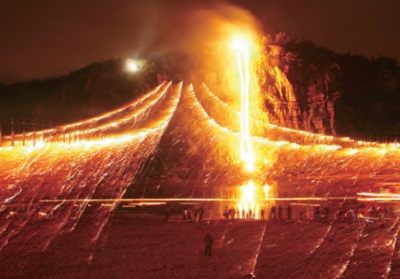
Hahoe Village in Andong was formed in the 17th century when some families of the Pungsan Ryu Clan settled there. The village, now containing about 450 traditional tile-roofed or thatched houses, is surrounded by the Nakdonggang River, with pine trees crowding the riverbank, creating a beautiful rural landscape. The village is also connected with a traditional performance, byeolsingut tallori, which is performed to invoke divine help for the village’s safety and prosperity, and Seonyu julbullori, a local firework festival held at riverside beaches.
The other historical village, Yangdong, located 16km northeast of Gyeongju, has a history of about 500 years. It consists of about 160 traditional houses, both tile-roofed and thatched, and is surrounded by attractive natural surroundings, shallow valleys and gentle hills. The village is prized not only for its attractive old houses but also for other heritage that preserve the influence of Confucian ideology and ancient customs.
Gyeongju in Gyeongsangbuk-do was once the capital of the ancient Korean Kingdom of Silla (57 BCE – 935) for about one millennium, and contains a great wealth of heritage sites and relics that reflect its remarkable cultural achievements. The remaining historical and cultural heritage led to the city’s registration as a UNESCO World Heritage Site, under the name of the Gyeongju Historic Areas, in 2000. Tangible evidences of Silla’s cultural glory include Bulguksa Temple, which was founded to represent the ideal world of Buddhism which Silla’s people aspired to, Seokguram, a man-made grotto admired for its unique architectural structure and outstanding sculptural works, and Cheomseongdae, which is regarded as Asia’s oldest extant astronomical observatory. The royalty and aristocracy of Silla left behind large tombs in and around today’s Gyeongju. Archaeologists discovered priceless treasures in some of these tombs, such as the image of a heavenly horse painted on a piece of white birch bark (Cheonmachong Tomb), and gold crowns lavishly decorated with exquisite and advanced skills (Geumgwanchong Tomb). Apart from the fabulous archaeological discoveries, these ancient tombs clustered in downtown Gyeongju create fantastic and fascinating landscapes in themselves.

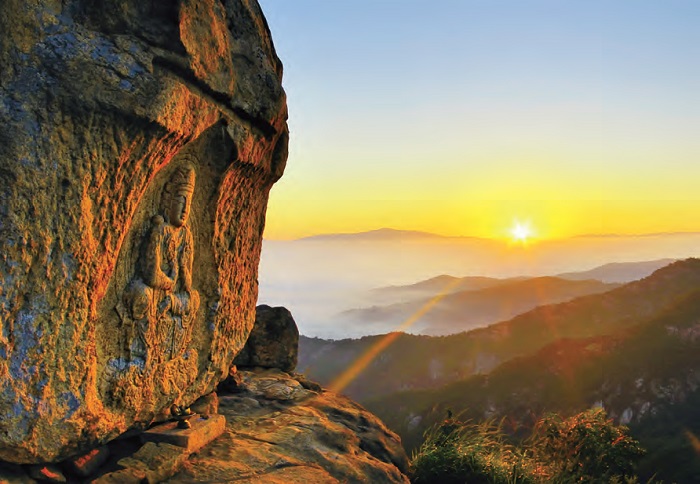
Namsan Mountain in Gyeongju. A seated Buddha image carved on a rock face on Namsan Mountain

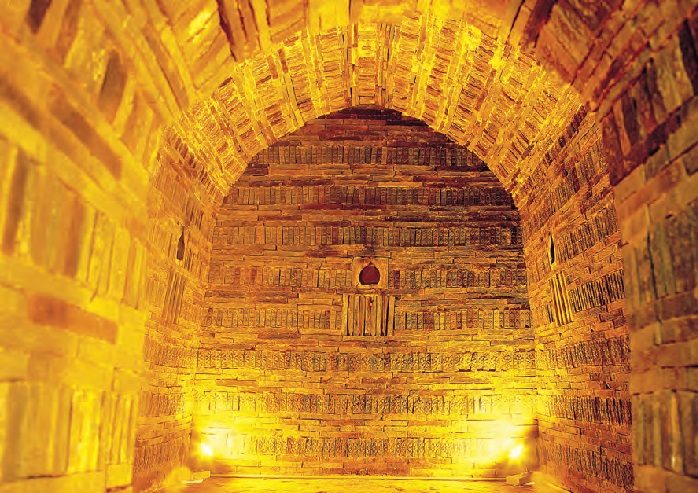
Tomb of King Muryeong (Gongju, Chungcheongnam-do). The burial chamber of the tomb of King Muryeong, the 25th ruler of Baekje, and his consort shows the influence of the Chinese Southern Dynasties.
Silla Buddhists in the 8th century made a great temple bell now known to be the “Sacred Bell of Great King Seongdeok.” As well as its imposing size, the bell is known for having several unique devices designed to help produce a clear, long lingering sound when struck, such as the “sound pipe”, and elaborate carvings decorating the outer surface of its body. Some of the most valuable treasures of Silla Buddhism, stone images and pagodas in particular, can be seen in Namsan, making Gyeongju’s guardian mountain one of the holiest places of Korean Buddhism.
Gongju and Buyeo, Capitals of Baekje
Gongju and Buyeo are two cities in Chungcheongnam-do, each of which served as the capital city of the ancient Korean Kingdom of Baekje during the period from the late 5th to the 7th century. The cultural achievements of Baekje in this period are best represented by the Tomb of King Muryeong and other ancient tombs in Gongju, Nakhwaam Rock, and Gungnamji Pond in Buyeo.
The Ancient Tombs in Songsan-ri, Gongju consist of seven tombs of Baekje’s royalty including that of King Muryeong and his consort. Archaeologists discovered inside the tomb a wealth of precious burial objects preserved in near original condition that now provide important clues to the lifestyle of Baekje’s people. Buyeo, which was the last capital of Baekje for 123 years until 660, also contains valuable relics dating from the cultural heyday of a Kingdom that exerted a powerful influence on neighboring countries. Other Baekje heritage sites preserved in the city, including Nakhwaam Rock, which is connected with the last days of Baekje, and Gungnamji containing the features of a Baekje palace garden, have now become major tourist attractions.
Hahoe Village in Andong and Yangdong Village in Gyeongju

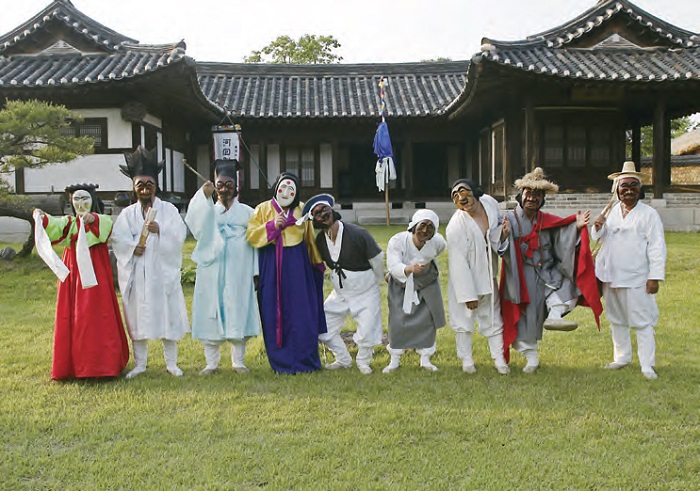
Hahoe Byeolsingut Tallori. A traditional mask dance preserved in Hahoe Village in Andong that satirizes the corrupt ruling elite of Joseon society

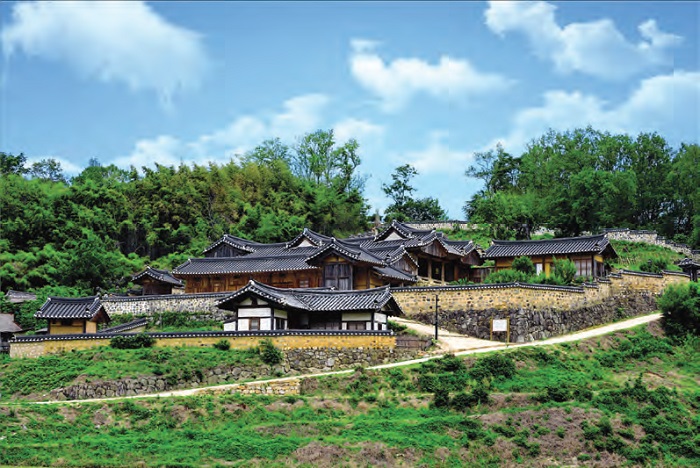
Yangdong Village in Gyeongju. A village that has maintained the traditional lifestyle for over 500 years

Seonyu Julbullori. This traditional firework festival involves hanging up bags of mulberry root charcoal powder upon four long (approx. 230m) ropes hung between Mangsongjeong Pavilion on the riverbank of Nakdonggang and the summit of Buyongdae Terrace across the river.
Hahoe Village in Andong was formed in the 17th century when some families of the Pungsan Ryu Clan settled there. The village, now containing about 450 traditional tile-roofed or thatched houses, is surrounded by the Nakdonggang River, with pine trees crowding the riverbank, creating a beautiful rural landscape. The village is also connected with a traditional performance, byeolsingut tallori, which is performed to invoke divine help for the village’s safety and prosperity, and Seonyu julbullori, a local firework festival held at riverside beaches.
The other historical village, Yangdong, located 16km northeast of Gyeongju, has a history of about 500 years. It consists of about 160 traditional houses, both tile-roofed and thatched, and is surrounded by attractive natural surroundings, shallow valleys and gentle hills. The village is prized not only for its attractive old houses but also for other heritage that preserve the influence of Confucian ideology and ancient customs.
Streets of Youth
Jongno and Cheonggyecheon
Jongno was one of the two districts, the other being Myeong-dong, that typified the early economic and cultural vibrancy of Korea in the 1970s and 1980s. There were, and still are, between today’s Jongno 2(i)-ga and 3(sam)-ga some of Seoul’s oldest movie theaters, the nation’s major bookstores, and famous private educational institutions including foreign language schools which keep the districts perpetually crowded with students.
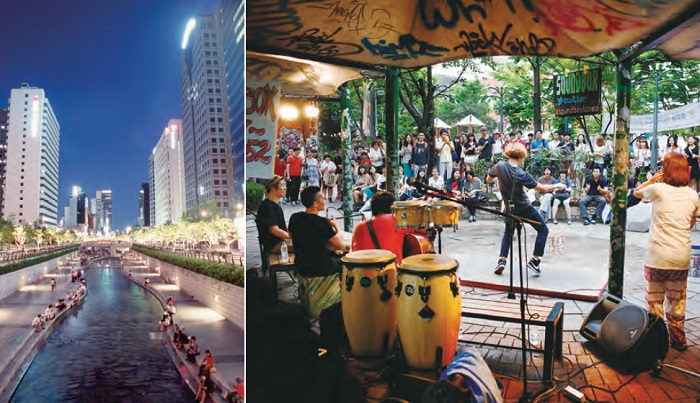
Cheonggyecheon, a historic stream cutting across the heart of Seoul, was restored and remodeled a few years ago and quickly emerged as one of the city’s top attractions. In the past the stream was a source of water for the families living around it, but it began to be covered over in the 1950s, and the overpass built over it came to be regarded as a symbol of Korea’s industrial growth during the 1960s and 1970s. The overpass, however, was demolished in 2003 as part of the project to restore the stream, which was completed two years later.
Hongdae Street (Hongik University Street)
It was during the early 1990s that Hongdae, or the area around Hongik University, saw an explosion of cafes and live music clubs drawing young music lovers from all across Seoul, gradually turning it into one of Seoul’s most dynamic cultural areas packed with fun-seeking youngsters. What differentiate the streets of Hongdae from other similar districts are the live performances of indie bands held at the clubs scattered around the district. The bands cover a variety of popular music genres, including rock, funk and techno music, for the young audiences that gather there every evening.
The Hongdae district also contains numerous art galleries committed to displaying original works by emerging young artists. Some of these artists join with others devoted to other forms of art such as music and dance, to put on collaboration performances in the streets. Garosu-gil Street of Sinsa-dong Literally “the tree-lined street of Sinsa-dong”, Sinsa-dong Garosu-gil is a street in Sinsa-dong in Gangnam-gu that is lined with gingko trees on both sides. The street and nearby alleys have recently grown into one of Seoul’s main attractions, attracting tens of thousands of fashion-minded people to its array of high-end coffee houses, art galleries, luxury boutiques and other fashion stores every day.
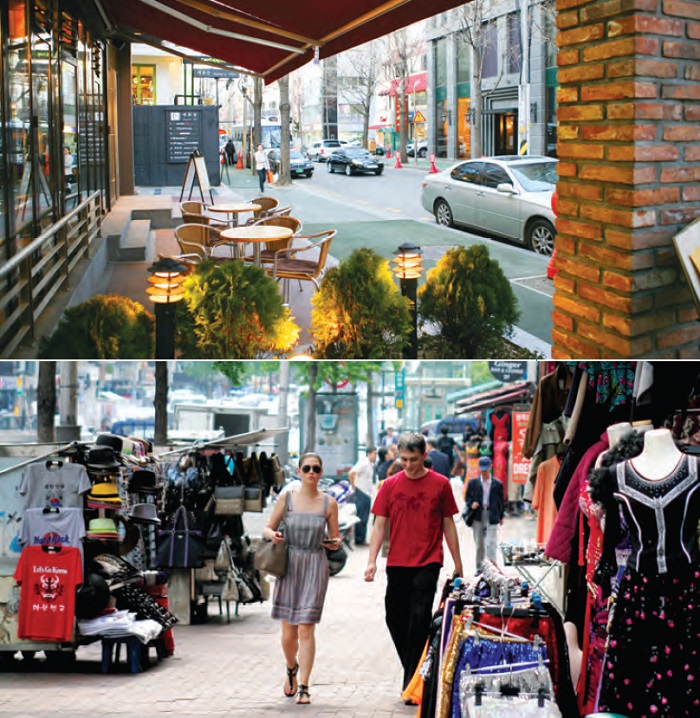
In the 1990s Garosu-gil began to attract ambitious young fashion designers, who opened shops along the road, eventually transforming it into a “fashion street.” The success of their shops was followed by the opening of other shops vending exquisite interior objects, furniture and personal fashion items.
Itaewon
Itaewon, located south of Namsan Mountain in the heart of Seoul, is one of the most popular tourist destinations in the city, particularly among foreign tourists seeking shopping, fun and thrills in more comfortable surroundings. The development of the district and the growth of its reputation among international travelers visiting Korea are largely related with the presence, since the Korean War (1950-1953), of the Eighth United States Army Base in nearby Yongsan. Today the district, encompassing Itaewon and nearby Hannam-dong, contains a number of foreign embassies including those of Germany, Denmark, Argentina, Rumania, Uruguay, Lebanon, Hungary, Brunei and Qatar, as well as the Seoul Central Mosque and diverse foreign communities.
Itaewon’s streets are packed with shops selling fashionable clothes and fashion items, nightclubs, bars and restaurants, many of them providing exotic, at least to Korean visitors, foods from Mexico, India, Vietnam and Turkey among other countries, and a distinctly cosmopolitan atmosphere. The district was designated by the Korean government as a Special Tourist Zone in 1997, and has since then held the Global Village Festival every October. Furthermore, street performances are held for foreign tourists on a daily basis.
Jongno was one of the two districts, the other being Myeong-dong, that typified the early economic and cultural vibrancy of Korea in the 1970s and 1980s. There were, and still are, between today’s Jongno 2(i)-ga and 3(sam)-ga some of Seoul’s oldest movie theaters, the nation’s major bookstores, and famous private educational institutions including foreign language schools which keep the districts perpetually crowded with students.
Cheonggyecheon, a historic stream cutting across the heart of Seoul, was restored and remodeled a few years ago and quickly emerged as one of the city’s top attractions. In the past the stream was a source of water for the families living around it, but it began to be covered over in the 1950s, and the overpass built over it came to be regarded as a symbol of Korea’s industrial growth during the 1960s and 1970s. The overpass, however, was demolished in 2003 as part of the project to restore the stream, which was completed two years later.

Cheonggyecheon Stream Plaza (up). An attractive space for relaxation and refreshment in the heart of downtown Seoul. Hongdae District. Streets crowded with young and ambitious artists and spectators
Hongdae Street (Hongik University Street)
It was during the early 1990s that Hongdae, or the area around Hongik University, saw an explosion of cafes and live music clubs drawing young music lovers from all across Seoul, gradually turning it into one of Seoul’s most dynamic cultural areas packed with fun-seeking youngsters. What differentiate the streets of Hongdae from other similar districts are the live performances of indie bands held at the clubs scattered around the district. The bands cover a variety of popular music genres, including rock, funk and techno music, for the young audiences that gather there every evening.
The Hongdae district also contains numerous art galleries committed to displaying original works by emerging young artists. Some of these artists join with others devoted to other forms of art such as music and dance, to put on collaboration performances in the streets. Garosu-gil Street of Sinsa-dong Literally “the tree-lined street of Sinsa-dong”, Sinsa-dong Garosu-gil is a street in Sinsa-dong in Gangnam-gu that is lined with gingko trees on both sides. The street and nearby alleys have recently grown into one of Seoul’s main attractions, attracting tens of thousands of fashion-minded people to its array of high-end coffee houses, art galleries, luxury boutiques and other fashion stores every day.
In the 1990s Garosu-gil began to attract ambitious young fashion designers, who opened shops along the road, eventually transforming it into a “fashion street.” The success of their shops was followed by the opening of other shops vending exquisite interior objects, furniture and personal fashion items.

Garosu-gil of Sinsa-dong (up). A street busy with fashionminded young shoppers. Itaewon (bottom). The Korean hub of international cultures
Itaewon
Itaewon, located south of Namsan Mountain in the heart of Seoul, is one of the most popular tourist destinations in the city, particularly among foreign tourists seeking shopping, fun and thrills in more comfortable surroundings. The development of the district and the growth of its reputation among international travelers visiting Korea are largely related with the presence, since the Korean War (1950-1953), of the Eighth United States Army Base in nearby Yongsan. Today the district, encompassing Itaewon and nearby Hannam-dong, contains a number of foreign embassies including those of Germany, Denmark, Argentina, Rumania, Uruguay, Lebanon, Hungary, Brunei and Qatar, as well as the Seoul Central Mosque and diverse foreign communities.
Itaewon’s streets are packed with shops selling fashionable clothes and fashion items, nightclubs, bars and restaurants, many of them providing exotic, at least to Korean visitors, foods from Mexico, India, Vietnam and Turkey among other countries, and a distinctly cosmopolitan atmosphere. The district was designated by the Korean government as a Special Tourist Zone in 1997, and has since then held the Global Village Festival every October. Furthermore, street performances are held for foreign tourists on a daily basis.
Tourist Attractions and Shopping Centers
Insa-dong
Insa-dong is a district in downtown Seoul that is packed with antique shops, antiquarian booksellers, art galleries, scroll mounters, craft workshops, brush shops, traditional teahouses, restaurants and bars that provide tourists with ample opportunities for an exciting cultural experience. The district had many places frequented by Korea artists, writers and journalists which have now begun to attract tourists from around the country and beyond. The Seoul Metropolitan Government designated Insa-dong as a District of Traditional Culture in 1988 and turns it into a car-free zone every weekend to create a more comfortable environment for visitors.
Myeong-dong
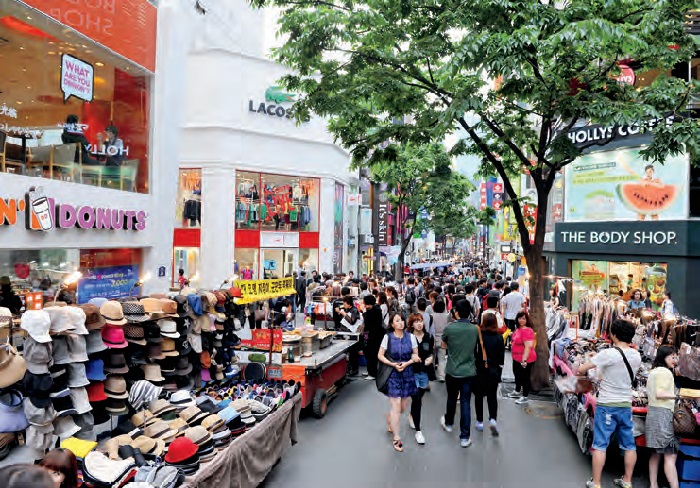
Myeong-dong has long been the busiest and most thriving shopping district in Korea where high-end shops and luxurious boutiques attract shoppers from all across Korea and tourists from different countries in Asia with luxury goods, brand garments, cosmetics, shoes, fashion accessories and souvenirs. The district has also been the national hub of finance and culture as well as commerce since the Korean War (1950-1953) and, in the 1970s and 1980s, was frequented by Korea’s most energetic, fashion-conscious, outgoing people.
The position of Myeong-dong in the Korean fashion industry has dwindled somewhat in recent times, but its influence on the Korean fashion market remains significant. Many of the world’s top fashion brands maintain or have opened new stores in the district, winning back fashion-minded shoppers from the newly emerging fashion streets in the Gangnam area as well tourists from overseas. The district also contains Myeongdong Cathedral, established in 1898 and a central figure to all Korean Catholics, and the historic Chinese Embassy.
Apgujeong Rodeo Street
Named after Rodeo Drive in Beverly Hills, and home to some of the most prestigious fashion stores in the region, Rodeo Street in Apgujeong-dong is widely regarded as the “mecca of Korean fashion” and a trendsetter in Korea. Rodeo Street is packed with luxury stores, including the flagship stores of the world’s top fashion brands, and upscale restaurants, cafes and bars. The street also contains stores selling special fashion items sought after by young fashionistas, and fully meets all the diverse needs of shoppers. In October, the street is transformed into the main venue for the Apgujeong Culture Festival which presents movies, hair shows, fashion shows, dance competitions and other exciting cultural events.
Insa-dong is a district in downtown Seoul that is packed with antique shops, antiquarian booksellers, art galleries, scroll mounters, craft workshops, brush shops, traditional teahouses, restaurants and bars that provide tourists with ample opportunities for an exciting cultural experience. The district had many places frequented by Korea artists, writers and journalists which have now begun to attract tourists from around the country and beyond. The Seoul Metropolitan Government designated Insa-dong as a District of Traditional Culture in 1988 and turns it into a car-free zone every weekend to create a more comfortable environment for visitors.

Insa-dong. One of the most popular destinations among foreign tourists in Seoul, the district is packed with antique shops, art galleries, craft workshops, traditional teahouses, restaurants and bars.
Myeong-dong
Myeong-dong has long been the busiest and most thriving shopping district in Korea where high-end shops and luxurious boutiques attract shoppers from all across Korea and tourists from different countries in Asia with luxury goods, brand garments, cosmetics, shoes, fashion accessories and souvenirs. The district has also been the national hub of finance and culture as well as commerce since the Korean War (1950-1953) and, in the 1970s and 1980s, was frequented by Korea’s most energetic, fashion-conscious, outgoing people.
The position of Myeong-dong in the Korean fashion industry has dwindled somewhat in recent times, but its influence on the Korean fashion market remains significant. Many of the world’s top fashion brands maintain or have opened new stores in the district, winning back fashion-minded shoppers from the newly emerging fashion streets in the Gangnam area as well tourists from overseas. The district also contains Myeongdong Cathedral, established in 1898 and a central figure to all Korean Catholics, and the historic Chinese Embassy.

Myeong-dong. Korea’s busiest fashion district and the number one attraction among international shoppers visiting Seoul
Apgujeong Rodeo Street
Named after Rodeo Drive in Beverly Hills, and home to some of the most prestigious fashion stores in the region, Rodeo Street in Apgujeong-dong is widely regarded as the “mecca of Korean fashion” and a trendsetter in Korea. Rodeo Street is packed with luxury stores, including the flagship stores of the world’s top fashion brands, and upscale restaurants, cafes and bars. The street also contains stores selling special fashion items sought after by young fashionistas, and fully meets all the diverse needs of shoppers. In October, the street is transformed into the main venue for the Apgujeong Culture Festival which presents movies, hair shows, fashion shows, dance competitions and other exciting cultural events.
Historical Heritage of Seoul
Seoul, the capital of the Republic of Korea, is itself an important part of Korea’s cultural heritage and the most popular attraction among overseas visitors to Korea. Although it is now one of the very largest modern metropolises in the world, its downtown area is enclosed by historic walls that were originally built over 600 years ago and contains a number of valuable historical heritage including Royal Palaces, fortress gates, and old residential districts.
Gyeongbokgung Palace
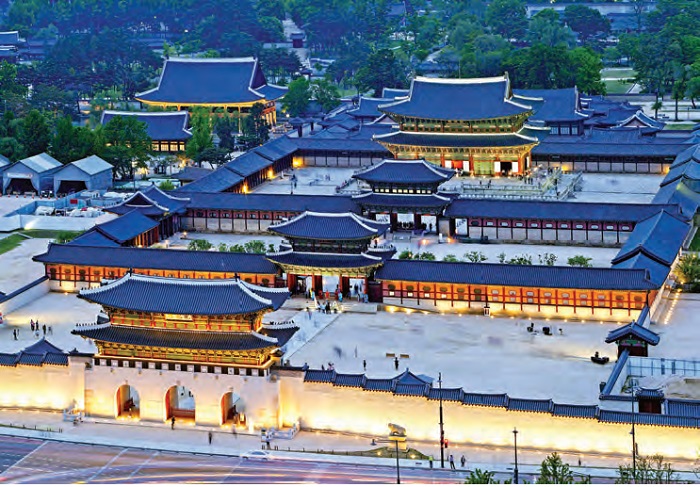
Gyeongbokgung Palace. The main Royal Palace of Joseon located at the heart of Seoul
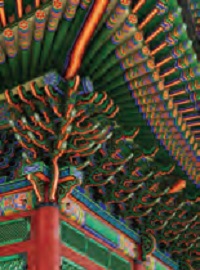
Dancheong Dancheong is a traditional method of decorating various palace and temple buildings with intricate patterns of the five cardinal colors, blue (symbolizing the east), white (west), red (south), black (north) and yellow (center).
Located at the foot of Bugaksan, the main mountain overlooking downtown Seoul, Gyeongbokgung was the principal Royal Palace for about 200 years from its construction in 1395, just three years after the foundation of the Joseon Dynasty (1392-1910), until it was burnt down just after the commencement of the Japanese invasion of Korea in 1592. Thereafter it remained in ruins for 275 years until 1867 when it was restored; but, less than fifty years later, it fell into the hands of Japanese colonialists who destroyed the front part of the palace to build the Japanese Government- General Building on the site. The latter building, a neo-classical structure, continued to be used to house government offices even after Korea was liberated in 1945 until it was demolished in 1996 as part of an effort to remove the remaining vestiges of the colonial period. Some of the ruins of the building were moved to the Independence Hall of Korea in Cheonan, Korea for public display.
Under a major renovation project to restore the palace starting in 1990, some of its buildings were restored and its main gate, Gwanghwamun, was moved to its original location. Today, the palace features some of the country’s most popular tourist attractions, including the majestic architectural pieces, Geunjeongjeon Hall and Gyeonghoeru Pavilion.
Changdeokgung Palace Garden
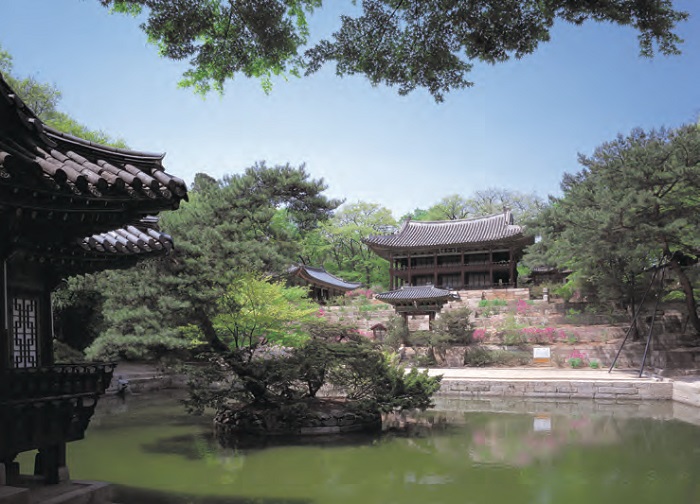
Changdeokgung Palace Garden. A view of the rear garden of Changdeokgung Palace, including Buyongjeong and Juhamnu Pavilions, with Buyongji Pond situated between them
The rear garden of Changdeokgung Palace, one of the Royal Palaces of Joseon (1392-1910) still standing in Seoul, has been widely praised for the harmony between exquisite architectural structures and its natural surroundings, and is now one of the most popular tourist attractions in Seoul. The garden, known as the “secret garden” (biwon), the “forbidden” (geumwon) or “rear garden” (huwon), was a preferred venue for royal events such as banquets and picnics. It features a pond and several exquisite pavilions that were built around it over a long period of time. The garden was open to the general public until the mid-1970s, but this caused severe damage which led to its closure for several years to restore it to its original condition. Only a part of the garden was reopened to the public in May 2004, but at present visitors need to make reservations in order to visit.
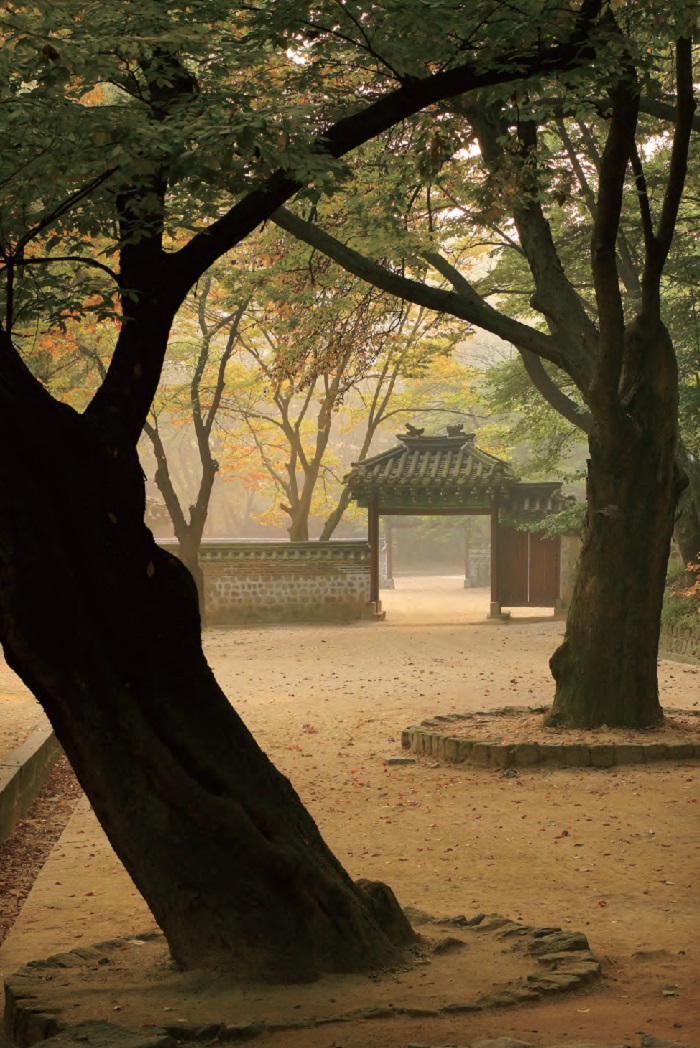
Geummamun Gate at the Changdeokgung Palace Garden in Jongno, Seoul
Deoksugung Palace
To most Korean people today Deoksugung Palace is largely connected with the desperate struggle of the Joseon Dynasty to survive amid the incursions of the major imperial powers at the turn of the 19th century. It was in 1897 that King Gojong proclaimed the launch of the Korean Empire and designated Deoksugung as the imperial palace after leaving the Russian legation where he had taken refuge one year earlier in a desperate attempt to keep his government free from the interference of Imperial Japan.
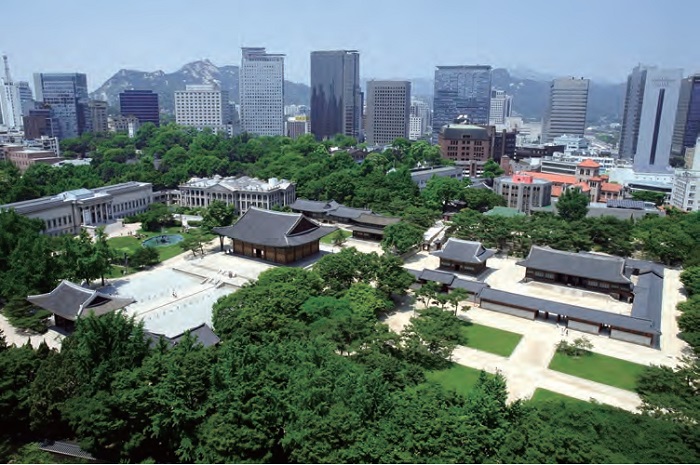
Deoksugung Palace. Unlike other Royal Palaces of Joseon, Deoksugung contains both Western style stone buildings and traditional wooden structures.
With the proclamation of the Korean Empire the palace began to draw attention from foreign diplomats working in the legations of the United States, Russia, Great Britain and France located around it.
Today, the clearest reminder of Deoksugung’s short-lived glory as the only imperial palace in Korean history is the changing of the palace guard ceremony, which takes place three times a day except for Mondays. The promenade along the southern wall of the palace has been particularly popular among young people seeking romantic ambiance.
Sungnyemun Gate (Namdaemun - South Gate)
Sungnyemun, or the ‘Gate of Exalted Ceremonies’, is the south gate of the old fortress wall that was built to protect the capital (todays’ downtown Seoul) of Joseon. It is the largest of the old fortress gates still standing in Korea today, and was designated as the National Treasure No. 1 in 1962. The pavilion-style wooden building forming the upper part of the gate was severely damaged by arson in February 2008, but was it was returned to its original form after a full-scale restoration project that took five years to complete.
The gate is often associated with the large complex of shopping facilities formed around it, including a traditional market which has steadily grown into a major tourist attraction. The area is always bustling with Korean and international shoppers seeking to purchase clothes, kitchen wares, domestic appliances and other commodities offered at reasonably low prices despite their good quality. Many of the shops doing business in the area run their own factories to maintain competitive pricing of the products they deal in.
The Namdaemun Market currently houses over 9,300 stores and attracts over 500,000 shoppers a day. It has formed a huge international trading network of Korean merchants scattered around the world, spending and earning a large amount of money through imports and exports.
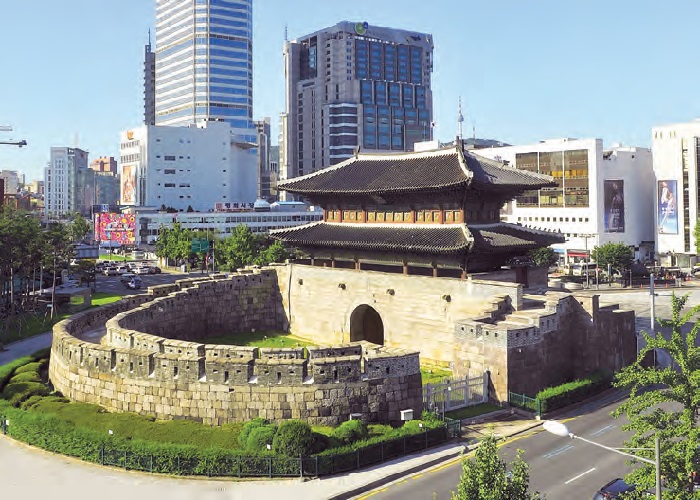

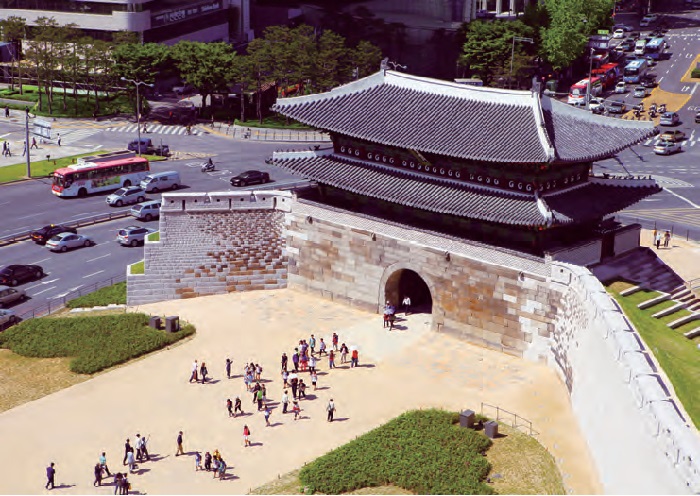
Seoul, the capital of the Joseon Dynasty, was protected by a long stone wall with eight gates, two of which, Sungnyemun (up) (Namdaemun or South Gate) and Heunginjimun (Dongdaemun or East Gate), can still be seen today. The first, literally “Gate of Exalted Ceremonies,” is famous for being the Korean National Treasure No. 1, while the second, Heunginjimun, is the only one of the eight fortress gates protected by a semicircular gateguard wall.
Heunginjimun Gate (Dongdaemun - East Gate)
Situated on the eastern part of the old fortified wall of Seoul, Heunginjimun (Gate of Rising Benevolence) attracts tens of thousands of people from across Korea and neighboring countries due both to its historic significance and its proximity to several large markets that have formed around it, including Gwangjang Market, Pyeonghwa Market, Sinpyeonghwa Market and Dongdaemun Market. All of these markets are particularly famous for the diverse fashion items they offer, clothes and accessories in particular. Compared with department stores that usually sell higher-priced luxury products, these markets have numerous wholesalers who supply competitively-priced good-quality products to retailers across Korea.
2017년 2월 26일 일요일
[서울 여행/투어] 이태원 경리단길 야밤의 산책
최근 날씨가 추어져서 걷기를 게을리했더니
몸이 찌뿌둥둥~ 해서 저녁 늦은 시간 산책하러
이태원 경리단길로 ~~!!
저녁 9시 30분이 넘어서...
|
서울 여행 / 투어
이태원 경리단길
역시 대한민국 젊음은 경리단길이겠죠?
낮과는 또다른 경리단길을 지금부터 소개합니다!!
우선 경리단길 가면서 항상 보는 서울N타워~~!!
낮에도 멋있지만, 밤이 되면 훨~씬 예뻐지는 N타워!!
특히 저 조명들의 색색깔이 예쁘게 바껴서 진짜 예쁜거 같아요
맥주 한 잔 하면서 찍은 사진~~~
피드 구독하기:
덧글 (Atom)